


By Dee Dee McNeil
February 1, 2026
CHRIS STANDRING – “TIME OF CHANGE” – Ultimate Vibe Records
Chris Standring, guitars/keyboards/programming/horn & string arrangements/composer; Andre Berry & Brian Bromberg, bass; Chad Wright & Dave Karasony, drums; Lenny Castro, percussion; George Whitty, piano; Rodney Lee, keyboards; Brandon Fields, tenor saxophone; Tom Saviano, alto saxophone; Michael Stever, trumpet; Erik Hughes, trombone.
Contemporary jazz guitarist, Chris Standring, has written and produced eleven new songs for his latest release, “Time of Change.” Standring says that 1970s cool jazz inspired the retro-rhythms and blues grooves that infuse these new songs. The single pulled from this album is “Hollywood Hustle” scheduled for a February 2nd debut.
Much of Standring’s songwriting on this project is nostalgic. However, his musical crew keeps the music current. Standring grew up in England, but spent the last thirty-five years as a resident of Southern California. In December of 2026, Chris Strandring will release a book called “A Jazz Life In Pictures” using snapshots of his life in various stages, telling stories about how his eighteen albums came about, as well as childhood photographs.
His album, “Time of Change” opens with a tune called “Photographs.” George Whitty takes a stunning and passionate solo on this tune.
The staccato rhythm section beneath the melodic guitar line on the song “Magnetic” is catchy! It is Standring’s original, created using two simple chords, but has a rich rhythmic groove enhanced by bassist, Andre Berry and groove master, Chad Wright on drums. Standring says his inspiration to write this one was the funky smooth jazz of the early Yellowjackets group.
The thing about Chris Standring’s music is that he systematically creates melodies that stick with the listener and are always accompanied by a rich rhythm section groove. “Slippin In These Streets” sounds a little bit like a Curtis Mayfield hit record called “Freddie’s Dead” that was part of the soundtrack from the Super Fly film. This is followed by a song that’s supposed to be the next single release, “All the Good Times”
“Quincy Jones is a producer I always looked up to for inspiration,” says Standring.
Every composition on this new album is masterfully written and produced. Chris Standring’s album release preview show will be held at the popular Spaghettini club in Southern California on February 7, 2026 in Seal Beach.
* * * * * * * * *
BETTY BRYANT – “NOTHIN’ BETTER TO DO” – City Hall Records
Betty Bryant, piano/vocals/composer; Robert Kyle, soprano & tenor saxophone/flute/guiro/ producer; Richard Simon & Hussain Jiffy, bass; Kevin Winard & Aaron Serfaty, drums; Kleber Jorge, guitar; Tony Guerrero, trumpet; Luanne Homzy, violin & viola; Niall Taro, cello.
When I see the name Betty Bryant printed across an album cover, I know in advance I’m in for a treat. She brings seven decades of swinging piano playing, unpretentious singing and unforgettable composing to every project. Her lyrics are born from a well-lived life. Betty is ninety-six years old and still going strong.
She brings tunes forward that have been hiding in the jazz archives and sings them alive, making each one brand new. The pianist and singer always offers interesting lyrics and great storytelling. Bryant opens with “You Are Not My First Love” arranged in a slow swing. It’s a provocative story that the singer delivers like a whispered conversation to a close friend. Betty Bryant makes us feel comfortable, being vulnerable and honest with her words and music.
This is followed by “I Can’t See For Lookin’,” a phrase I often heard my grandmother use years ago. This story unfolds like pages from a diary, sung with believability and emotional honesty. The same holds true for the blues standard “He May Be Your Man (But he Comes to See Me Sometime).” Bryant brings that Kansas City blues touch to her piano playing. She knows how to set the mood, play the groove, and sell the song.
Betty Bryant’s music draws me in like quicksand. The tune that inspired this album titled (I Haven’t got Anything Better To Do) was penned by Lee Pockriss and Paul Vance in 1969. I remember it was originally recorded and released by Brazilian bossa nova vocalist, Astrud Gilberto. Betty makes it her own, adding strings to this arrangement that features Luanne Homzy on violin and Niall Taro on cello. I also enjoyed the guitar solo of Kleber Jorge. This song may have a double entendre meaning. Although it is a love song, the words also apply to this talented nonagenarian’s life in music. Betty is blasé and unassuming when she takes to the stage or when she chats with you at the bar. There is an air about Betty Bryant that says, I do what I love and I love what I do. So, the title of her album capsulizes that concept. It explains her continual turn-out of creative music, as well as her soulful delivery of songs that reflect lessons of life and living. She couldn’t say it any more precisely than what her album cover states, “Nothin’ Better To Do.”
Betty’s memory of Kansas City speakeasies and/or after-hours-places is captured in her original composition called “Mama Sue.” The story unfolds like poetry or ‘rap,’ recapturing a time of live music, alcohol and mouth-watering bar-b-que that made “Mama Sue’s” place the spot to be.
Her producer, sax man and close friend, Robert Kyle, has contributed a down-home blues tune to the project called “OWrite Then.” He plays a mean tenor saxophone during this presentation and Betty Bryant gets to strut her fingers across the 88-keys, bringing that blues she learned to play from Jay McShann to the forefront. Seasoned veteran and educator, Richard Simon brings his big, bad, double bass into the spotlight to offer an engaging solo, while Kevin Winard pushes the tune forward with his power drums.
The Cool Miss B has been sharing her talents, her songwriting, piano playing and singing to California audiences since 1955. Before that, she was a working musician in Kansas City. Bryant has travelled the world, sharing her very personal music as far away as Oman, a country bordering Saudi Arabia, Yemen, and the United Arab Emirates. She has performed in Brazil and for years performed at the Tableaux Lounge in Tokyo, Japan. In 1987, her hometown of Kansas City, Missouri gave her the keys to the city and a famous photo of Betty with Jay McShann hangs in the lobby of the Kansas City American Jazz Museum. She has released 14 critically acclaimed albums. At ninety-six years old, Betty Bryant’s singing and piano playing haven’t lost a beat!

* * * * * * * * * *
WES SMITH – “WE, THE FUNKY – VOL 1.” –
Los Angeles based saxophonist and composer, Wes Smith, brings the world a contemporary jazz album that reflects his musical journey. He comfortably blurs the lines between pop, jazz, R&B and smooth jazz. Smith has worked with some of the legends of our time, including Stevie Wonder, Booker T. Jones, Poncho Sanchez and Justin Timberlake. He’s recorded with Pharrell Williams, Jennifer Lopez, Zendaya and Robin Thicke. Consequently, this album steps forward with deep grooves and spicy funk rhythms.
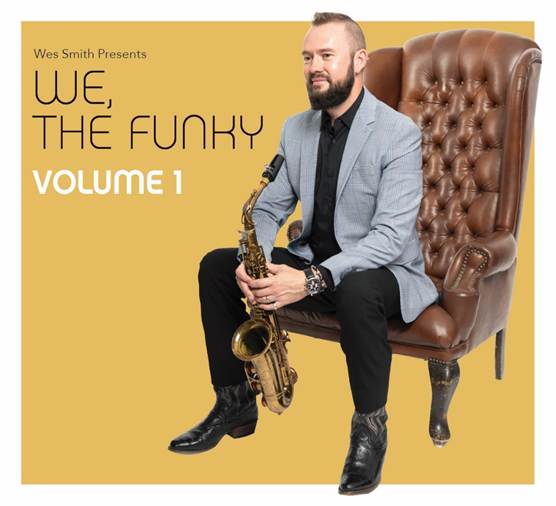
Wes Smith has composed and arranged all the music, beginning with the title tune, “We, The Funky.” The arrangement actually begins more smooth jazz than funk until the break. That’s when Donald Barret on drums steps into the spotlight. His rhythm patterns and soloing changes the complexion of this arrangement, along with electric bassist, Frank Abraham. Sam Barsh adds his Fender Rhodes piano parts. Then the party is in full force.
Smith’s former albums boast “the Funk” and sound more like loops and dance house grooves. For example, the Wes Smith “Juice” release.
This album, on the other hand, has more legato horn lines. Although harmonically appropriate, I feel the ‘legato’ part takes away the punch and drive. If the same arrangements had included punchy horn lines with the same harmonies, it would have better supported ‘the funk.’
Smith holds a Master’s in Jazz Studies from the University of Southern California and a Bachelor’s in Music from the Eastman School of Music in Rochester, New York. In describing his recent release, Smith says:
“My time in Los Angeles has been good to me. This record is about the sunshine and joy of that experience, and about the relationships that have made my musical journey so special.”
His original song, “Baby Steps” is meant to capture the happiness of fatherhood, mixed with the uncertainty that becoming a parent can bring. “Ventura Penthouse” reflects a moderate tempo tune where someone could be enjoying their Penthouse life, lying quietly on the couch and listening to a smooth jazz tune like this one. It features a bright trumpet solo by Maurice “Mobetta” Brown. Wes Smith plays Rhodes Piano on this track. Wes is also responsible for all the synthesized programming on this album. In addition, Smith is a multi-instrumentalist and woodwind player who adds flute, alto flute, soprano and alto saxophone to this project.
Only tracks one and two have funk arrangements. The album title threw me off a little bit, because the other three songs are not funky at all.
Band credits: Wes Smith, alto & soprano saxophone/flute/alto flute/Fender Rhodes Piano/synthesizers/mixing & editing; Frank Abraham & Dimitry Goredetsky, electric bass; Donald Barrett, drums; Sam Barsh, Rhodes piano; Erik Hammer & Adam Hawley, electric guitars. TRUMPET: Christopher Bautista, Maurice “Mobetta” Brown & Michael Cottone. TROMBONES: Khrystian Foreman & Justin Kirk.
* * * * * * * * * * *
DOUG MacDONALD TRIO – “LIVE IN BEVERLY HILLS” – Dmac Music
Doug MacDonald, guitar/composer; Lou Shoch, bass/vocals; Billy Paul, drums.
Over Thirteen years ago, Doug MacDonald played a concert at the Beverly Hills Art Show. It was on May 19, 2012, when his trio consisted of the dynamic Billy Paul on drums and the late, great bassist, Lou Shoch. As a jazz journalist who has listened to and reviewed a long string of the MacDonald recordings, this one would have to be among the top five on my preference list.
There is so much good energy and musicality on this album, it just leaps off my CD player and into my listening room. Beginning with “Samba De Orfeo” with MacDonald strumming his guitar with rhythmic clarity and joy. The trio is off and running. Lou Soch takes the lead, playing the melody on his electric bass, followed by MacDonald’s innovative guitar solo. When they spotlight Billy Paul on drums, his mastery shines. This tune should get plenty airplay.
“It was a magical day. For a musician like Doug, who has made many recordings of his own and has performed with the likes of the Clayton-Hamilton Orchestra, Bill Holman, and more. Doug’s excitement about this project says it all,” drummer Billy Paul expressed in the liner notes.
It was Billy Paul who recorded this date and recently brought the historic moment to MacDonald’s attention. There are two original compositions by MacDonald on this album. Both swing hard! The first is “Unimpressed” a minor-toned gem that was inspired by “So What” and “Impressions.” MacDonald’s third track, called “Mall Blues” is a favorite of mine. It showcases each of the trio members as superb soloists. Lou Shoch struts his walking bass tones across the room and Billy Paul’s drum solos are outstanding.
They put the pots on to boil on their arrangement of “The Night has a Thousand Eyes.” It opens with MacDonald’s a ‘Capella guitar singing the melodic introduction rubato. Then the band jumps into the mix with all six feet. They are off and running.
Every tune on this album demands attention and promises enjoyment. It’s another plume in the jazz cap that MacDonald proudly wears. This album joins the more than thirty album releases MacDonald has recorded over his long and illustrious career. It is definitely one of his best.
* * * * * * * * * * * *
JAMES JUDSON – “SONGS OF MY DREAMS” – Independent Label
Singer, composer, musician, James Judson is one of those people who dreams the music, wakes up with a start, then quickly writes the melody down. This debut album is full of dreamy love songs.
“I wake up with a song, sometimes fully formed, sometimes just a melody and a few key lyrics. I’ll be the first to admit these songs aren’t written in the traditional sense, they just show up,” Judson explains in his liner notes.
With the guidance of Grammy-winning producer, Tim Sonnefeld, these songs, that once evolved in the ethereal space between dreams and reality, come alive on this project. The musicians are some of the best Los Angeles has to offer.
Judson has written eleven out of the thirteen songs for this album, with two ‘covers.’ He opens with his swinging original “Is There A Chance” propelled by an entire orchestra.
His arranger, producer, Sonnefeld slows the groove down to an orchestrated blues on “The Shadow of Your Smile” where Judson’s warm, charming tone caresses each note with care. The third Track that he calls “Stars Past the Milky Way” sounds like it’s based on the popular song “On the Street Where You Live.” Another song called “Walking a Sidewalk” sounds very much like “I’ve Got You Under My Skin.” Often, jazz musicians take liberties, writing new songs over old familiar chord changes. All of Judson’s melodies are clearly his own.
On the tune “All of Me,” the drummer, Charles Ruggiero, lays down a terrific groove, using mallets. Judson has paired up with vocalist Laura Cole to sing this familiar standard. Pleasantly, they add the opening verse that is rarely heard.
James Judson grew up in Boulder, Colorado, part of a large coal mining family. Music touched him early in life. By thirteen, he was working in a rock band as their drummer and lead vocalist. In high school, he joined a Top forty band that played all the ‘Earth, Wind & Fire’ and ‘Chicago’ hits of the day. They performed at weddings, state fairs and local venues. But, once married, with a growing family, including six children, Judson reached a crossroad. He chose to put his efforts into a growing construction business, rather than to pursue his fickle music career, where pay checks are unsteady. With “Songs of My Dreams,” he returns to his passion and deep love for music.
This is an album that reminds us of the Duke Ellington and Count Basie days. Judson has a soothing, smooth baritone voice. The lyrics to his original songs are well written. His melodies roll like sugar off his tongue, sweetly enticing us with his big band orchestration and infectious tone. This is an impressive recording from an artist who heard these songs in his dreams. How wonderful that with fortitude and determination, he has brought them to life on this debut album.JAMES JUDSON ORCHESTRA: James Judson, vocals; Tim Sonnefeld, string & horn arranger/co-producer/Hammond B3 organ/Fender Rhodes keyboard/guitar; Gary Matsumoto & Max Haymer, piano; Mike Gurrola, Dan Lutz, & Charles Glenn, bass; Kelvin Holly, Anders Mouridsen & Steve Cotter, guitars; Charles Ruggiero, drums; Leddie Garcia, percussion. Justin Flynn, horn arranger. TRUMPETS: Michael Campagna, Aaron Janik, Dan Fornero, Dave Richards, & Mike Cordone; SAXOPHONES: Bob Sheppard, Anton Sushev, Bob Reynolds, Doug Webb, & Jason Fabus. TROMBONES: Erik Hughes, Ryan Dragon, Joshua Brown, & Todd Eames. VIOLINS: Eliza James, Olga Ivanenko, Laurann Woods, & Lily Honigberg. VIOLAS: Jennifer Wu & Troy Everett. CELLOS: Jean-Paul Barjon & Judy Kang. GUEST SINGER: Laura Cole.
Fred Hersch
The Surrounding Green
(ECM)
A major pianist ever since 1979 when he worked regularly with Art Farmer and recorded with Billy Harper and Sam Jones, few of Fred Hersch’s many fans probably know that, as a member of the New England Conservatory Jazz Repertory Orchestra back in 1976, he made his recording debut playing songs associated with Paul Whiteman’s 1920s big band.
Many years have passed since then with Hersch recording dozens of timeless recordings that are filled with originals and standards that he enjoys. An influential pianist with a relaxed style and a sound of his own, Hersch teams up with bassist Drew Gress and drummer Joey Baron on his latest ECM album.
The music is typically thoughtful, quietly creative, and filled with subtle surprises. Hersch performs three originals (including a picturesque “The Surrounding Green”), Ornette Coleman’s “Law Years” (one can easily imagine the altoist sitting in for this stirring version), and a song apiece by Egberto Gismonti, the Gershwins, and Charlie Haden (the always-beautiful “First Song”). Gismonti’s “Palhaco” is given an interpretation that is both energetic and joyful while “Embraceable You” is mostly unrecognizable until the theme finally emerges at the performance’s conclusion. All seven performances, including Hersch’s optimistic “Anticipation” which closes the set, are quite enjoyable.
The Surrounding Green is easily recommended and available from www.ecmrecords.com and www.amazon.com.

Betty Bryant
Nothin’ Better To Do
(Bry-Mar Music)
In listening to pianist-singer Betty Bryant’s latest album (recorded a year ago), it is difficult to believe that she was 95 at the time. It is true that her interpretations of blues and swinging pieces are generally at relaxed tempos and her singing and playing are gentle. But her piano playing is inventive, her vocalizing is witty and sometimes a little saucy, and she certainly sounds timeless.
Joined by Robert Kyle, who in addition to tenor contributes excellent soprano and flute solos, bassist Richard Simon (with Hussain Jiffry on two numbers), and drummer Kevin Winard (Aaron Serfaty is on two selections), Betty Bryant still sounds very much in prime form. Among the highlights are “You Are Not My First Love,” “He May Be Your Man,” the light Latin piece “Time Was,” and the bard bop blues “Owrite Then” which has trumpeter Tony Guerrero making the group a quintet. Two numbers have Luanne Homzy (on violin or viola) and cellist Niall Taro forming a string quartet, the first time in her career that Ms. Bryant has had a chance to record with strings.
Betty Bryant is a joy to see live (be sure to catch her occasional club appearances) and that happiness can be felt throughout this worthy CD which is available from www.bettybryant.com and www.amazon.com.
Art Blakey and the Jazz Messengers
Strasbourgh 82
(Gearbox)
Drummer Art Blakey led many versions of the Jazz Messengers during 1955-90. A hard bop institution, the Jazz Messengers served as a “finishing school” for many up-and-coming young jazz artists before they went out on their own and became bandleaders.
The 1980-82 version of the Jazz Messengers which featured trumpeter Wynton Marsalis (who was just 18 when he joined Blakey), tenor-saxophonist Bill Pierce, and either Bobby Watson or Branford Marsalis on alto, gained a lot of acclaim. The next version of the group has been somewhat underrated but it served as a launching pad for trumpeter Terence Blanchard and altoist Donald Harrison who joined Pierce in the frontline.
The two-CD set Strasbourg 82 is a previously unreleased concert recording from Apr. 1, 1982, less than three months after Wynton Marsalis left the group, taking brother Branford with him. It is quite historic because it contains the earliest recordings of Blanchard and Harrison. The band, with pianist Johnny O’Neal (who had recently succeeded the departing Donald Brown) and holdovers Pierce and bassist Charles Fambrough, was coming together quickly. Blanchard and Harrison would play with Blakey for three years before they formed their own short-lived group.
At this early stage, Terence Blanchard was already technically skilled but did not have his own easily identifiable sound yet. Donald Harrison was more adventurous (bordering on the avant-garde in some of his solos) then he would become in later years. Bill Pierce was solid, reliable and mature in his playing while never being overly predicable, Johnny O’Neal was a swinging bopper, and Fambrough (one of Blakey’s more creative bass soloists) was stimulating in support of the lead voices. As for Art Blakey, at 62 he was still very much in his prime and constantly pushing his sidemen to stretch themselves and develop their own voices.
The nine selections on this twofer include some standbys (“Along Came Betty,” “Blues March,” and “Moanin’”), a song apiece by former members Bobby Watson (“Fuller Love”) and Donald Brown (a blazing version of “New York”), Ron Carter’s “Eighty One,” features for Harrison who is quite explorative on “I Can’t Get Started” and O’Neal who adds some touches of Art Tatum to “Old Folks” plus Fambrough’s “Little Man.”
Overall this is an above-average effort and an important transitional set from Art Blakey’s Jazz Messengers, a set that is easily recommended and available from www.amazon.com and www.gearboxrecords.com.
Vancouver Jazz Orchestra
Meets Brian Charette
(Cellar Music)
The 17-piece Vancouver Jazz Orchestra was founded by altoist James Danderfer in recent times and this release on Cellar Music (www.cellarlive.com) is its debut recording. Comprised of world class musicians who are based in Vancouver, British Columbia, the purpose of the group (beyond performing rewarding music) is to showcase the writing and playing of musicians from that area.
With the exception of two pieces (Herbie Hancock’s “The Sorcerer” and Brian Charette’s “Honeymoon Phase”), all of the arrangements and compositions are from local players. The music often recalls the type of swinging yet soulful big band charts that were played in the mid-1960s by Oliver Nelson and his contemporaries.
Organist Brian Charette (based in New York) is the album’s main guest. He solos on six of the ten selections and is a welcome presence throughout. Trumpeter Brad Turner is also a guest on two numbers and the other main soloists include tenor-saxophonist Steve Kaldestad, trombonist Andy Hunter, trumpeter Julian Borkowski, and guitarist Dave Sikula. Altoist Danderfer has a fine spot on “Colour Contrast” while the label head (and excellent tenor-saxophonist) Cory Weeds is one of several soloists on the closing “The Same Old You With The Same Old Blues.”
The Vancouver Jazz Orchestra is a project well worth supporting and its enjoyable music on Meets Brian Charette promises to be a joy for modern big band fans.
Maximilian Hering
The Gathering
(Klang Raum Records)
While none of the names on this release will be well-known to American jazz fans, this is a high-quality album that should be of strong interest. The Gathering is a quintet set headed by 31-year old German jazz drummer Maximilian Hering who contributed five of the nine group originals. It is at least his fourth album as a leader. Featured are flutist Fernando Brox, altoist Edu Cabello who doubles on bass clarinet, trumpeter Victor Carrascosa, bassist David Munoz, and the leader-drummer with pianist Lucia Fumero guesting on two numbers.
The music is forward-looking free bop with occasional (and generally brief) avant-garde outbursts. It covers a variety of moods and grooves, often swings, and at times is a little reminiscent of the early Ornette Coleman Quartet. The musicians are all top-notch improvisers who are not shy to both embrace melodies and stretch themselves during their unpredictable solos.
The set begins with the joyful “Moles On Her Skin” which has a colorful tradeoff between Brox’s flute and Cabello’s alto. The thoughtful “Ojo de madera” takes its time before Brox solos while driven by Munoz’s walking bass. “The Gathering’ begins with some wild ensembles, eventually becoming a free bop tune. “519 km is too far for kissing you” is a melodic and moody piece that features pianist Fumero. The brief “Oliver” has long tones from the horns and some drum breaks. The catchy accompaniment by Munoz and Hering on “Route A56” adds to the happy feeling heard during the alto and flute solos, “Entre tu y yo” is a ballad featuring Cabello’s bass clarinet, and “Gleisgefluster” puts the emphasis on sounds and long tones. The consistently inventive program concludes with ‘Summer in PT,” a swinging medium-tempo blues.
The Gathering, which is available from www.maxhering.com, grows in interest with each listen. These fine musicians are well worth discovering.
Joe Magnarelli
Decidedly So
(Ccllar Music)
A top-notch hard bop trumpeter since the mid-1980s, Joe Magnarelli has been so consistent throughout his career which includes at least 16 albums as a leader that it is easy to take him for granted. A solid player with a warm tone and a wide range, Magnarelli’s playing is in a similar style as that of Blue Mitchell, Lee Morgan, and Freddie Hubbard but very much spoken in his own voice.
On Decidedly So, Magnarelli heads a quintet also featuring the superb trombonist Steve Davis, pianist Jeremy Manasia, bassist Clovis Nicholas, and drummer Rodney Green. The set is comprised of four originals by the trumpeter, one by Davis, and three standards. The first half of the program consists of Magnarelli’s uptempo modal blues “D.J,” Davis’ dark but swinging “Decidedly So,” a complex “Good Health, and the ballad “10th Anniversary.” Good as those are, it is the second part of this CD that takes honors. A jazz waltz version of “This Nearly Was Mine” inspires some inspired trumpet, trombone and piano solos. The swinging “When I Grow Too Old To Dream” (which is fortunately not modernized) is quite joyous with the soloists excelling over the appealing chord changes. Magnarelli is next showcased on a memorable ballad version of “When I Fall In Love” before the set concludes with the cooking “Jimmy’s Blues.”
Throughout Decidedly So, Magnarelli, Davis and the up-and-coming Manasia make consistently rewarding statements while Nicholas and Green offer a solid foundation and keep the music swinging. The results are as rewarding as one would hope, making Decidedly So (available from www.cellarmusicgroup.com) an easily recommended acquisition.
Ian Dogole
The Last Trane To Africa
(Global Fusion)
There will be a lot of John Coltrane tributes released in 2026 since this year is the centennial of his birth. Percussionist Ian Dogole’s CD will certainly considered one of the more rewarding ones. On this set, the versatile Dogole is heard on udu, djembes, floor tom, ankle bells, cymbals, maracas llaneras, African talking drum, kalimba, and miscellaneous bells and rattles. He has occasional brief solos and introductions but mostly plays in the background. Considering how colorful his spots are (such as the introduction on “Africa” and his relatively lighthearted playing on “Dahomey Dance”), I wish that he had taken a more dominant role.
Dogole is joined by Richard Howell (tenor and soprano), pianist Frank Martin, Fred Randolph or Gary Brown on bass, and Sheldon Brown who plays tenor, soprano or bass clarinet on four of the six songs. The set is comprised of three Coltrane compositions, two of the other songs that he played, and Bill Lee’s “John Coltrane.” Both Howell and Brown are powerful soloists and they are the main stars although pianist Martin is also excellent.
The Last Trane To Africa begins logically with “Africa” which has a strong statement by Howell on tenor and a particularly fiery solo by Brown on soprano. “Out Of This World” is given a dark treatment with plenty of interaction by the two tenors while “Dahomey Dance,” which has Brown sounding quite effective on bass clarinet, is happier. Bill Lee’s “John Coltrane” is a modal piece in 6/4 on which Howell sings and scats. “Tunji” has poetry by Avotcja that is only worth hearing once before the group (other than Brown) tears with spirit into “Afro Blue.”
On The Last Trane To Africa (which is available from www.amazon.com), Ian Dogole succeeds in paying homage to John Coltrane without copying the classic quartet. The results are passionate and will be enjoyed by Coltrane fans.
Tyreek McDole
Open Up Your Senses
(Artwork Records)
Jazz has long suffered from a lack of male jazz singers. Ever since the passing of Joe Williams and Mel Torme in 1999, there have only been a handful of male vocalists who are on the world class level, most notably Kurt Elling and Gregory Porter.
Tyreek McDole, who is 26, is a recent contender. He has a warm voice, a versatile style and, while he plays it safe throughout much of his debut, Open Up Your Senses, he displays plenty of potential.
McDole is joined on most selections by pianist Caelan Cardello, bassist Rodney Whitaker, and drummer Justin Faulkner. Helping out on various selections are trumpeter Michael Cruse, guitarist Logan Butler, Sullivan Fortner (on organ and electric keyboards on three numbers), and tenor and soprano saxophonist Dylan Band. There are also guest appearances by pianist Kenny Barron on Thelonious Monk’s “Ugly Beauty” and Pharoah Sanders’ son tenor-saxophonist Tomoki Sanders on “The Creator Has A Master Plan;” the latter plays quite credibly in his father’s style.
Among the other selections are a version of “Umbrella Man” that uses the same arrangements as Dizzy Gillespie did on the Timex television special where he had a one-time collaboration with Louis Armstrong, Leon Thomas’ “The Sun Song,” the swing tune “Under A Blanket Of Blue” (which has some fine playing by pianist Cardello) and a spirited if predictable version of “Everyday I Have The Blues.”
While I wish that Tyreek McDole would have stretched himself much more rather than mostly sticking to melody statements (why should the horn players have all of the fun?), Open Up Your Senses (available from www.amazon.com) is a good start to his career.
Takashi Asai and Daniel Villeneuve
The Way We Are
(Nseo)
This is a fascinating set of music. Recorded at six sessions, these eight improvisations are comprised of duets by pianist Takashi Asai and percussionist Daniel Villeneuve. Often when one thinks of free improvisations, it is of atonal explorations that can be violent, noisy, and abrasive, but that is certainly not the case here.
The eight selections all have similar titles that are obviously irrelevant to the music: “The Way We Are,” “Are We,” “Are We The Way,” “The Way,” “We Are,” “We The Way Are,” “We Are The Way,” and “We Are We.” With Villeneuve primarily heard on congas, setting the tempo with rhythmic patterns, it is up to Asai to spontaneously create new pieces. He does that by utilizing beautiful chords, seemingly simple melodic ideas, and gradually building up his ideas.
“The Way We Are” finds the pianist creating a hypnotic piece that uses repetition creatively. “Are We” has a Latin feel and a catchy and playful melody while “Are We The Way” is a bit freer but still rhythmic. On “The Way,” Villeneuve plays his congas melodically, taking the place of a bass to an extent while Asai builds his musical thoughts off of the conga patterns. “We Are” finds Asai letting the music breathe with spaces for conga breaks. “We The Way Are” has a two-bar rhythmic phrase by the pianist being the basis for the piece.
The intriguing set concludes with two out-of-tempo performances (“We Are The Way” and “We Are We”) that are a bit spiritual and feature thoughtful piano and waves of quiet sounds from Villeneuva.
The Way We Are (available from www.amazon.com can be used as background music for meditations but reveals plenty of beauty and subtle creativity when listened to closely. It is certainly worth checking out and savoring.
John Vanore & Abstract Truth
Easter Island Suite
(Acoustical Concepts Inc.)

The discovery of Easter Island (which is over 2,000 miles off of the coast of Chile) must been a shock back in 1722 because it contained nearly 1,000 statutes. Their origin and original purpose remain a mystery to this day.
Trumpeter John Vanore composed and arranged the four-part “Easter Island Suite” to musically depict the island’s discovery. The music is dramatic, thoughtful, and full of the feeling of wonder. Oddly enough the suite was recorded over a rather long period of time. The first movement, “Discovery,” is from 1989, the next two parts (“Gods & Devils” and “The Secret Caves”) are from 2012 with the closing “Rano Raraku (Journey To The Lake)” being from 2024. Each part was recorded by a 13-14 piece ensemble. While the personnel naturally changes from piece to piece (although a few musicians are on all four parts), there is a unity and consistency to the performances.
The star soloists are tenor-saxophonist Mike Falcone on “Discovery,” Vanore and tenor-saxophonist Bob Howell on “Gods & Devils,” flutist Michael Mee and Bob Howell on tenor during “The Secret Caves” with Brian Landrus’ bass clarinet adding to its eerie atmosphere, and Vanore, Mee (on alto), and pianist Ron Thomas during “Rano Raraku.”
The music on Easter Island Suite (available from www.johnvanore.net) would be an ideal soundtrack to a documentary on the unique island although it succeeds independently of the album’s “plot.” John Venore deserves praise for persevering and seeing this worthy project to its conclusion.
Lynn Keller
My Man’s An Undertaker
(Spooky Records)
A wide-ranging jazz singer with an appealing voice, Lynn Keller (the daughter of the late trumpeter Art Depew who led the Harry James Orchestra for many years) has sung with a variety of big bands (including Pat Longo’s and the Woody James Legacy Big Band) and many different combos in addition to being a long-time producer and vocalist with the New Randy Van Horne Singers. While one would not necessarily call her a “haunting” singer, she fulfills that role quite well throughout My Man’s An Undertaker.
When a set of music includes such numbers as “Devil May Care,” “That Old Black Magic,” “Bewitched,” “St. James Infirmary,” and even “Monster Mash,” it is not surprising that the results are not overly somber. During the set of “spooky” tunes (it is a bit ironic that the singer has long had a label called Spooky), Lynn Keller swings the material while joined by a big band in Los Angeles. There are some worthy short solos along the way including some excellent plunger mute work from a trumpeter who might be Jeff Kaye but unfortunately the listing does not identify the soloists. There are also several singers who occasionally accompany Ms. Keller (most notably on “Transylvania Choo Choo”) and a male who is in the spotlight during the happily silly “Monster Mash.”
Lynn Keller, who sings with a smile in her voice, is in excellent form throughout. Even though I wish that the arrangements were more outlandish considering the subject matter which after all includes “Your Heart Is As Black As Night” and “My Man’s An Undertaker,” this is an enjoyable recording whether heard around Halloween or at any time of the year. It is available from www.lynnkellermusic.com.
Scott Silbert Quartet
Dream Dancing
(Self-Released)
Tenor-saxophonist Zoot Sims (1925-85) was always famous for swinging. A very consistent player throughout his four-decade career, Sims (whose cool tone practically defined the “Four Brothers” sound) always sounded inspired and never seemed to have played an unworthy chorus.
To celebrate Sims’ centennial in 2025, Scott Silbert joined together with pianist Robert Redd, bassist Amy Shook, and drummer Chuck Redd to pay tribute to Zoot. Silbert, who worked with the United States Navy Band for years and had recent success with his big band album Jump Children, has a tone similar to that of Sims on both tenor and soprano; Zoot occasionally played the latter in his later years.
Dream Dancing is very much like one of the albums that Zoot Sims recorded with pianist Jimmie Rowles. The latter was well known for unearthing obscure classics. On Dream Dancing, the 13 songs (only “Blues For Louise” is an original) include such lesser-known gems as “Deep In A Dream,” Johnny Mandel’s “Low Life,” “Round My Old Deserted Farm,” and “Shadow Waltz” along with a variety of veteran songs that are not performed very. Most of the tempos are relaxed with Silbert paying homage to the melodies before creating swinging and melodic solos that easily recall Sims. Pianist Redd has his own fresh chord voicings that fall within the jazz tradition while Shook and Chuck Redd (a hero for refusing to perform at the renamed Kennedy Center) offer solid support.
Dream Dancing is easily recommended to those who enjoy the type of swinging bop-based music that Zoot Sims effortlessly performed for decades. It is available from www.scottsilbertmusic.com.